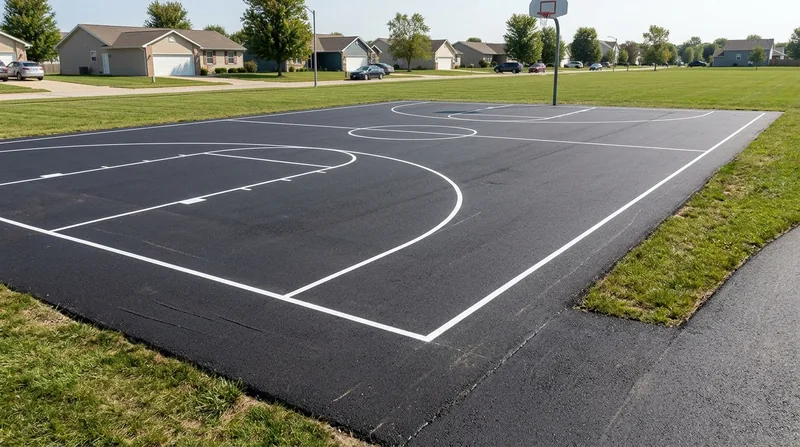




Champaign's flat prairie terrain and freeze-thaw winters demand precision when building sports courts and paths. The black silt loam and glacial till underneath most of the city holds moisture longer than aggregate base, which means a sports court and path paving job here starts with proper grading and compaction before the asphalt goes down. We grade the base to exact specifications, pour hot mix to tight tolerances, and pitch the surface just enough to shed water without affecting play or walking comfort. Whether you are building a new court at a school, community center, or residential property in Champaign, Urbana, Savoy, or the surrounding area, the foundation work determines whether the court stays flat and playable for years or develops the soft spots and drainage problems that plague courts built on poor base prep. Our crews understand how Champaign's wet ground behaves, and we build courts that handle both the spring thaw and summer storm runoff without pooling.
Why Sports Court and Path Paving Matters in Champaign's Climate
A basketball or tennis court sitting on the wrong base fails faster in Champaign than almost anywhere else in the Midwest. The prairie silt loam that sits under most residential and institutional properties in this area is rich and fertile for farming, but it is also moisture-retentive and soft. When water sits beneath asphalt and freezes in winter, it heaves the slab. When it thaws in spring, the base settles unevenly, leaving low spots where water pools again. Sports courts demand a dead-flat playing surface, and that flatness can only hold if the base is engineered and compacted correctly from the start. A poorly prepared base means resurfacing or replacement within five to seven years instead of fifteen to twenty.
- We remove topsoil and organic material down to stable subgrade, then import and compact aggregate base to specification and proof-roll the surface to confirm density.
- We pour hot mix asphalt in lifts, compacting each layer while it is still hot to achieve the density and smoothness that courts require.
- We pitch the finished surface to drain toward the perimeter without creating dead zones where water collects or affecting play mechanics.
- We specify thickness and tonnage in writing, so you know exactly what is going into the ground and what it will cost.
A court built this way stays playable and requires only routine maintenance, not emergency patching.
Key info: Champaign's freeze-thaw cycle runs from November through April, with the most damaging swings occurring in February and March. A court that is not graded and pitched correctly will show failure within the first spring thaw. The cost of fixing a failed base after paving is three to five times the cost of doing it right the first time.
For more on how we approach base preparation and grading, see our gravel driveway installation and grading page, which covers the same foundation principles that apply to courts and paths.
How We Build Sports Courts and Paths in Champaign: Step by Step
Every court and path job follows the same discipline: site assessment, base design, material import and compaction, asphalt paving, and finish. We take measurements and photos on the first visit, evaluate drainage and soil conditions, and provide a written estimate that includes tonnage, thickness, and the specific pitch we will use to shed water. Once you approve, we schedule the work around weather and site access. The job moves fast once it starts, but we do not rush the compaction or the finish.
- We clear and strip the site, removing topsoil and any unstable material down to firm subgrade.
- We import and spread aggregate base material, then compact it in lifts with a vibratory roller until it reaches the density specified in our estimate.
- We proof-roll the base with a loaded truck to confirm that soft spots do not exist and that the surface will support the asphalt and the traffic it will carry.
- We set up the grade and pitch, using string lines and laser levels to ensure the court drains correctly without creating low zones.
- We heat and pave the asphalt in lifts, compacting each layer while hot to achieve the smoothness and density the court requires.
- We allow the asphalt to cool and cure before opening it to play; new asphalt should not be sealed for the first six to twelve months while the material hardens.
The entire process typically takes one to two weeks from site prep to finish, depending on weather and the size of the court or path.
Example: A school in Mahomet needed a new basketball court after the old one developed alligator cracking and soft spots in the north corner. We excavated the failed asphalt and base, imported new aggregate, and compacted it in three lifts. The new court was paved in two days and opened for play two weeks later. The written estimate specified 4 inches of hot mix and 6 inches of compacted base, totaling 87 tons of material. Cost was $12,400 including grading, material, and labor.
For related work on asphalt driveway paving and installation, we apply the same attention to base and compaction, though residential driveways typically use a thinner base and do not require the same flatness tolerance.
Sports Court and Path Paving Methods and Materials
| Approach | Description | Best for |
|---|---|---|
| New court construction | Full site prep, aggregate base import and compaction, hot mix asphalt poured in lifts, finished to tight flatness and pitch tolerance. | School grounds, community centers, residential properties, parks, and new courts where the base does not exist or is compromised. |
| Court resurfacing and overlay | We mill the existing asphalt, evaluate the base, and pour new hot mix if the base is sound; if the base is soft, we remove it and rebuild. | Existing courts with surface cracks but solid base, or courts that need thickness added to restore flatness and extend service life. |
| Walking and recreational paths | Lighter base and asphalt thickness than courts, but same attention to drainage pitch and compaction; paths can be narrower and follow topography more flexibly. | Connecting routes between buildings, parks, and neighborhoods; paths that do not require the flatness tolerance of a playing surface but must shed water and hold up to foot and light vehicle traffic. |
| Court repair and patching | We patch localized failures, pothole damage, and soft spots; if more than 30 to 40 percent of the court surface is failed, resurfacing or full replacement is more cost-effective. | Courts with isolated damage, weather-induced cracks, or minor base settlement in specific areas; not suitable for courts with widespread alligator cracking or base failure. |
Sports Court and Path Paving Cost in Champaign: What to Expect
A new basketball or tennis court in Champaign typically runs from $8,500 to $18,000, depending on the size of the court, the condition and stability of the existing ground, and the thickness of the base and asphalt required. A full-size basketball court is roughly 4,700 square feet; a tennis court is about 2,600 square feet. The cost per square foot varies, but a typical court job costs between $1.80 and $3.50 per square foot once you account for base preparation, material, and labor. Walking and recreational paths are lighter and less expensive, typically ranging from $3 to $6 per linear foot depending on width and base conditions.
The biggest cost driver is the base. If the site has poor drainage, soft soil, or a failed existing base, we have to excavate deeper and import more aggregate. If the ground is stable and well-drained, the base cost drops. The second driver is size; larger courts benefit from better per-unit pricing on material and labor. The third is timing; spring and fall are our busy seasons, and summer jobs can sometimes be scheduled faster and at better rates.
We provide a written estimate that breaks down material tonnage, asphalt thickness, base depth, and labor. That estimate is free and carries no obligation. For a detailed pricing overview and to discuss your specific project, visit our pricing page or call us at (447) 895-0417 for a free estimate.
Sports Court and Path Paving Near Me: What Champaign Homeowners and Facility Managers Should Know
Hiring a paving contractor for a sports court or path is a significant investment, and the quality of the finished work depends almost entirely on the contractor's attention to base preparation and compaction. Before you sign a contract, verify that the contractor is fully insured and ask to see proof of coverage. Ask for at least two other recent references, preferably courts or paths built within the last three years, and call those references to ask about the quality of the work and whether the court has required repairs or resurfacing. Get written estimates from at least two contractors, and make sure each estimate specifies the thickness of the asphalt, the depth and material of the base, the tonnage of material being used, and the pitch or drainage plan.
Check with your local municipality or your HOA before work begins. Champaign, Urbana, Savoy, and other municipalities in this area have different rules about permits, impervious surface limits, and stormwater management for new paved areas. Some villages require a permit for any paved surface larger than a certain size; others do not. If your court or path is part of an HOA community, the HOA may have architectural standards or material requirements that govern what you can build. Verify these requirements before you get estimates so that you are not surprised by a need to redesign or seek approval after the contractor has already started.
Illinois law requires a utility locate (811 call) before any excavation that disturbs the ground. Make sure your contractor calls 811 before beginning site prep. Ask about the contractor's experience with Champaign's soil conditions and freeze-thaw climate. A contractor who understands the risks of soft base and poor drainage in this region will build a court that lasts. For more information or to discuss your project, contact us for a free estimate.
Sports Court & Path Paving in Champaign: Pricing Guide
| Service | Price | Details |
|---|---|---|
| Basketball court (full-size, new construction) | Starting at $8,500 | Includes site prep, 6-inch compacted base, 4-inch hot mix, grading and pitch for drainage |
| Tennis court (full-size, new construction) | Starting at $6,800 | Smaller footprint than basketball; same base and asphalt specifications, adjusted for court dimensions |
| Recreational or walking path (per linear foot) | Starting at $3 | Width, base condition, and drainage requirements affect final cost; typically 4 to 8 feet wide |
| Court resurfacing or overlay (existing sound base) | Starting at $4,200 | Milling, new asphalt, and finish; base repair or replacement increases cost significantly if base is soft |
| Site with poor drainage or soft base | On estimate | Requires additional excavation, base import, and compaction; assessed during free site visit |
| Free estimate and site visit | No charge | Response within 24 hours; call (447) 895-0417 to schedule; written estimate includes tonnage and thickness |
Indicative pricing, the exact cost depends on square footage, finish, and site access. Free personalized estimate within 24h at (447) 895-0417.


